Scan first
Decide what matters before reading every detail.
Rejuran Healer and Vitaran I are both polynucleotide (PN) skin boosters, made by different manufacturers. We did not find a published head-to-head study of the two, so we cannot point to evidence that one works better than the other. What decides the choice is the area treated and what is causing the concern, and the honest answer can be "neither". Below: what the two share, what has not been verified, what the evidence shows and where it stops, and five checks to run before any injection.
The short answer
- The product name does not settle it. Under-eye discolouration, fine lines and rough texture each have more than one possible cause, and finding which one applies is a matter of examination, not of picking a brand.
- We found no evidence that ranks the two products. The studies we could verify do not name Rejuran or Vitaran, and none compares them.
- Check the box, not the brochure. The manufacturer, the Thai FDA (อย.) listing and the source material are facts you can look up before you agree to treatment.
Continue by chapter
Open only the section you need.
What Rejuran Healer and Vitaran I have in common
Both are injected into the skin (intradermally), and both are marketed as polynucleotide skin boosters, which is why they are compared so often. That shared category is all the comparison can safely rest on: the products are not interchangeable, and the studies below were not run with either of them.
Where they differ, and what has not been verified
| Question | Rejuran Healer | Vitaran I | Status on this page | | :--- | :--- | :--- | :--- | | Product type | PN skin booster | PN skin booster | Same category, different products | | Manufacturer | PharmaResearch (Korea), as named in product listings | Not verified here | Confirm the manufacturer name on the box | | Source material | Not verified here | Fish-derived, as confirmed by the clinic (species not stated here) | Confirm the source with the doctor, especially with a fish allergy or a dietary restriction | | Thai FDA (อย.) listing | Not verified here | Not verified here | Look it up at fda.moph.go.th | | Published head-to-head study | None found | None found | We found no evidence that ranks the two | | Session count and interval | Set by the product information and the doctor | Set by the product information and the doctor | No fixed number is promised | | How the quote is built | Per unit as supplied | Per unit as supplied | Compare quotes unit by unit |
"Not verified here" means we could not confirm it from a manufacturer or regulator document when this page was written. It is not a finding that the product lacks it.
What the evidence says, and where it stops
- A 2026 systematic review of randomized trials (Cureus) searched PubMed, Embase and the Cochrane register and included seven randomized trials with 183 participants in total. Four trials tested polynucleotide and three tested polydeoxyribonucleotide (PDRN); four addressed skin rejuvenation. The authors report that no serious treatment-related adverse events occurred and that local reactions were mostly mild and short-lived. They also state that the evidence is limited by small samples, protocols that differ from study to study, and the absence of standardized preparations, and they did not pool the results. Risk of bias was low in three studies, "some concerns" in three and high in one.
- A 2026 observational study of the eye area (Journal of Cosmetic Dermatology) followed 42 patients who received a polynucleotide product, Pluryal Silk, in two sessions three weeks apart. Patient-rated appearance of the lower eyelid and crow's feet improved at 1, 3 and 6 months, peaked at 3 months and eased somewhat by 6 months. Swelling and discomfort were mild at two days. The study had no control group and a single clinic, and outcomes were mainly patient-reported.
Neither study used Rejuran or Vitaran. They support the general idea that polynucleotide injections can improve skin quality for some people, not a claim about either product, a duration of effect or a number of sessions.
Why the cause of under-eye discolouration matters more than the brand
Dark colour under the eye is not one condition. Thin skin that lets the tissue beneath show through, a hollow that casts a shadow, and pigmentation are different causes, and they call for different approaches. Which one applies is decided by examination, in good light and often with the face at rest and in movement. Neither the studies above nor any manufacturer claim on this page tells you which cause you have. If the examination points away from injections, a careful clinic says so.
Five checks before any injection
- Which product, exactly? Ask to see the sealed box: product name, manufacturer, lot number and expiry date.
- Is it listed? Search the exact product name on the Thai FDA (อย.) website, fda.moph.go.th. If you cannot find it, ask for the registration details before you agree.
- Tell the doctor your history, and ask for the insert. Allergies (including to fish), pregnancy or breastfeeding, an active skin infection, recent fillers and any dietary restriction are all things the doctor needs to know. The product insert states that product's own contraindications and precautions, so ask to read it for your exact product.
- Compare quotes by unit. Ask what one unit is (per cc, per box or per session), how much product it holds, which area it covers and how many units the plan needs. Two quotes in different units cannot be compared until both are converted to one.
- Get the plan in writing. The number of sessions and the interval should be tied to a named product. Be cautious of a fixed session count or a promised length of effect with no product or source behind it.
After the injection
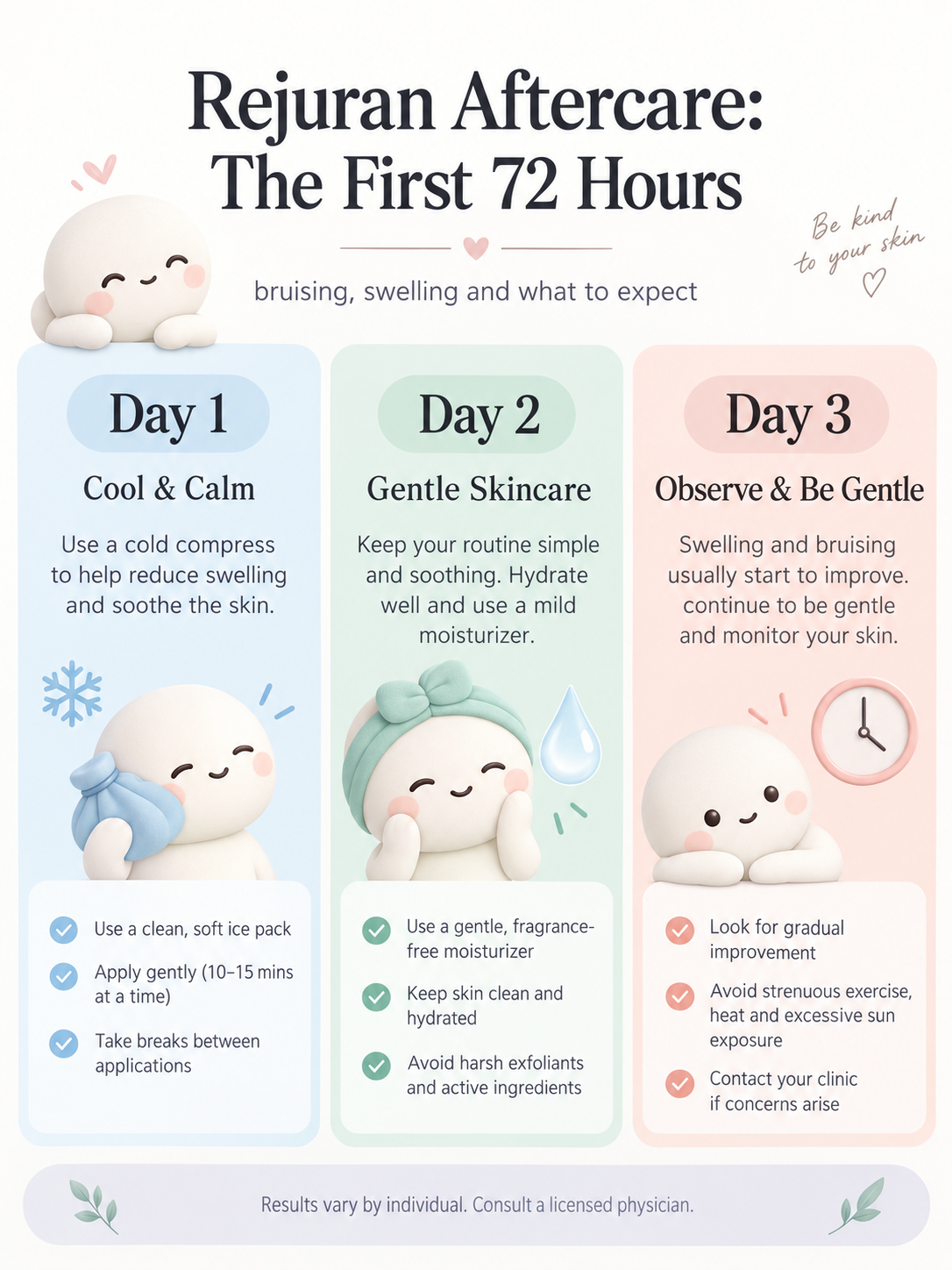
Swelling and small bruises are the usual questions in the first days. See the Rejuran aftercare guide for the first 72 hours.
Related VERZO pages
- Program Rejuran
- Program Vitaran I
- Program Nucleofill, a third polynucleotide option
- Program Skin Booster overview
- Juvelook vs Rejuran, a different skin-booster comparison
- Book a consultation
Sources
- Polynucleotides and Polydeoxyribonucleotides for Skin Rejuvenation, Postoperative Scar Prevention, and Wound Healing: A Systematic Review of Randomized Clinical Trials. Cureus, 2026. PMC13453133
- Prospective Observational Study of Polynucleotide Injections for Periorbital Rhytides. Journal of Cosmetic Dermatology, 2026. PMC12905022
Medical Disclaimer
Results vary depending on individual skin and body conditions.
Please consult a physician before treatment.
Results are not guaranteed.