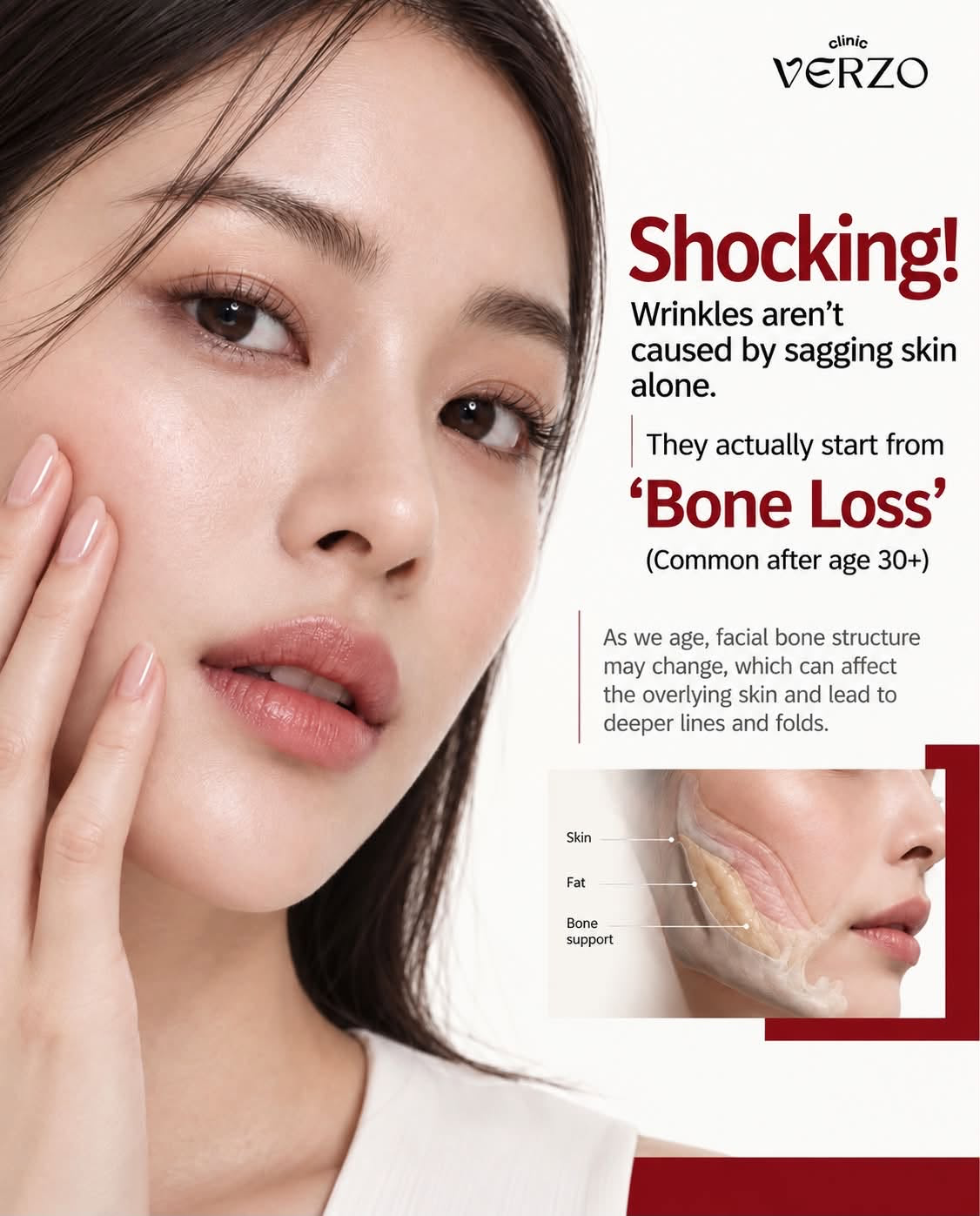
"Why do wrinkles and facial sagging still become more noticeable, no matter how expensive my skincare is?" And another one: "Why can a face start to look tired and older even when the surface of the skin still looks well cared for?"
The short answer is that facial aging is a multi-layer process, and only one of those layers is the skin you can see in the mirror. This article walks through what peer-reviewed anatomy research says changes beneath the surface from the 30s onward — in bone, in fat and in muscle — and why that changes what an honest assessment should look at.
The face ages from the inside out
Aesthetic-medicine reviews describe facial aging with a layered framework: the skin deteriorates, deep fat deflates, superficial fat descends, and the proportions between layers shift (Swift et al., Aesthetic Surgery Journal, 2020/21). Their timeline places some of the earliest visible signs — forehead and glabellar lines, brow descent, crow's feet and the beginnings of nasolabial folds — in the 30s or earlier, with midface projection loss and marionette lines typically following in the 40s.
In other words: the crease you first notice in your early 30s is usually the surface readout of changes that started underneath.
The bone layer: a slow, quiet remodeling
The facial skeleton is not fixed in adult life. A review of facial-CT studies (Mendelson & Wong, Aesthetic Plastic Surgery, 2012) describes predictable, site-specific resorption with age:
- The orbit widens. The lower-outer and upper-inner orbital rims recede — the lower-outer change can begin by middle age — which reduces the support beneath the lower eyelid and brow.
- The maxilla retrudes. Even in people with their natural teeth, the maxilla's angle measured roughly 10 degrees smaller in over-60s than in under-30s in the cited studies, and the pyriform aperture around the nose enlarges.
- The mandible changes shape. The jaw angle increases while ramus height and body height decrease, and a relative concavity develops in the pre-jowl region — one reason jowls appear where they do.
The authors' key point: these bony shifts are small in absolute millimeters, but they move the attachment points of ligaments and muscles, and the overlying soft tissue amplifies them. The visible consequences — tear-trough deformity, malar mounds, deepened nasolabial folds, jowling — cluster exactly where skeletal support is weakest.
The fat layer: deflation and descent at the same time
Facial fat is not one continuous layer. It is organized into compartments, and they do not all age the same way:
- Deep fat generally atrophies — it loses volume.
- Superficial fat repositions — it descends and can bulge against the retaining structures that hold it.
When the deep medial cheek fat deflates, the superficial cheek fat above it has less scaffolding underneath and slides forward and down — which is one mechanism behind a deepening nasolabial fold. Harvard Health summarizes the same mechanism for a general audience: with age, facial fat "loses volume, clumps up, and shifts downward." The temples, notably, show the greatest percentage volume loss of the face, which is why temple hollowing reads as aging even when the cheeks still look full.
The skin and muscle layers: the part you already knew — and its limits
The skin layer is real too: collagen breakdown accelerates while synthesis slows, and elastin biosynthesis drops steeply from the 40s to 50s, so skin recovers its shape more slowly after every expression. Repeated muscle action etches dynamic lines into a surface that now resists bouncing back.
What skincare can meaningfully do is support this layer — hydration, barrier repair, retinoid-based collagen maintenance, sun protection to slow extrinsic damage. What it cannot do is reposition a fat compartment or restore the projection of a retruding maxilla. That is not a failure of your moisturizer; it is a different layer of the problem.
Why "which layer?" is the real question
A recurring question in Chinese-language aesthetic communities (Xiaohongshu, Bilibili) frames this well: is my nasolabial fold a gap to fill, or a descent to reposition? Practitioner content increasingly warns against automatically filling the fold when the mechanism is midface descent — adding volume into a line that exists because tissue above it has slid forward can make the midface look heavier, not younger.
The honest answer is that it depends on which layer is doing the work in your face: skeletal support, deep volume, superficial descent, skin quality, or muscle action — and often a combination. That is why a structured, physician-led facial assessment reads the face in layers before recommending anything, and why a plan that starts from a trend (or from a single product category) is guessing.
What an assessment covers
A whole-face consultation typically reads:
- Skin quality — texture, elasticity, how light diffuses across the surface.
- Soft-tissue volume — which compartments are full, flat or have shifted.
- Skeletal support — the projection and symmetry of the structure everything sits on.
- Muscular action — where expression muscles pull and what they have etched.
From that, options are matched to layers, with observation windows between steps — and sometimes the honest recommendation is to change nothing yet.
At VERZO CLINIC in Bangkok, facial assessments are performed by licensed physicians, and the written plan is yours to take away and think about, whether or not it leads to treatment.
Individual anatomy differs; findings, options and outcomes are discussed in person, case by case, before anything is scheduled. Results vary by individual; a licensed physician's in-person assessment is the reference for any decision.